News
LIG D&A successfully demonstrates AI-powered intelligent command and control for unmanned surface vessels
2026.06.02
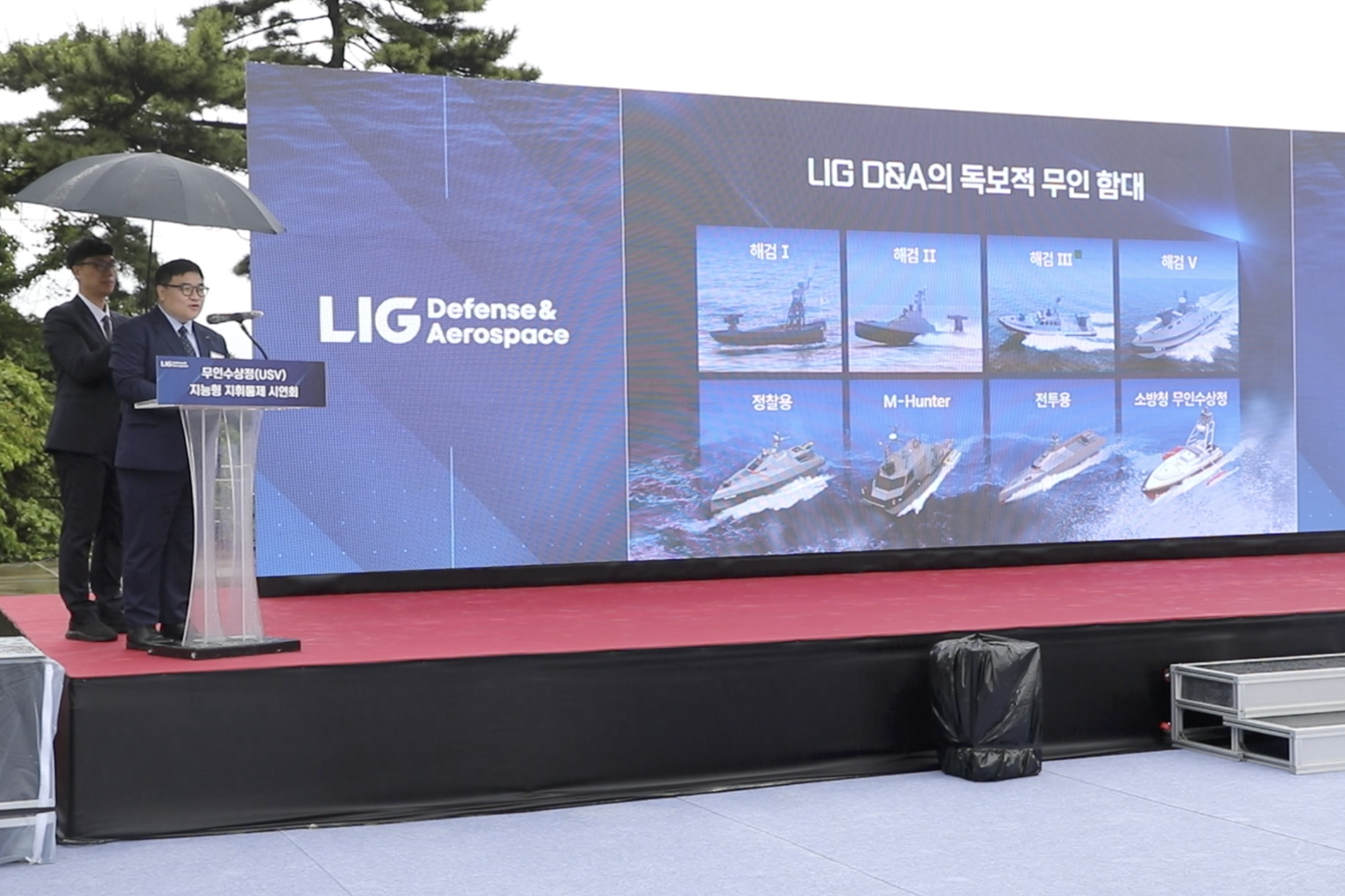
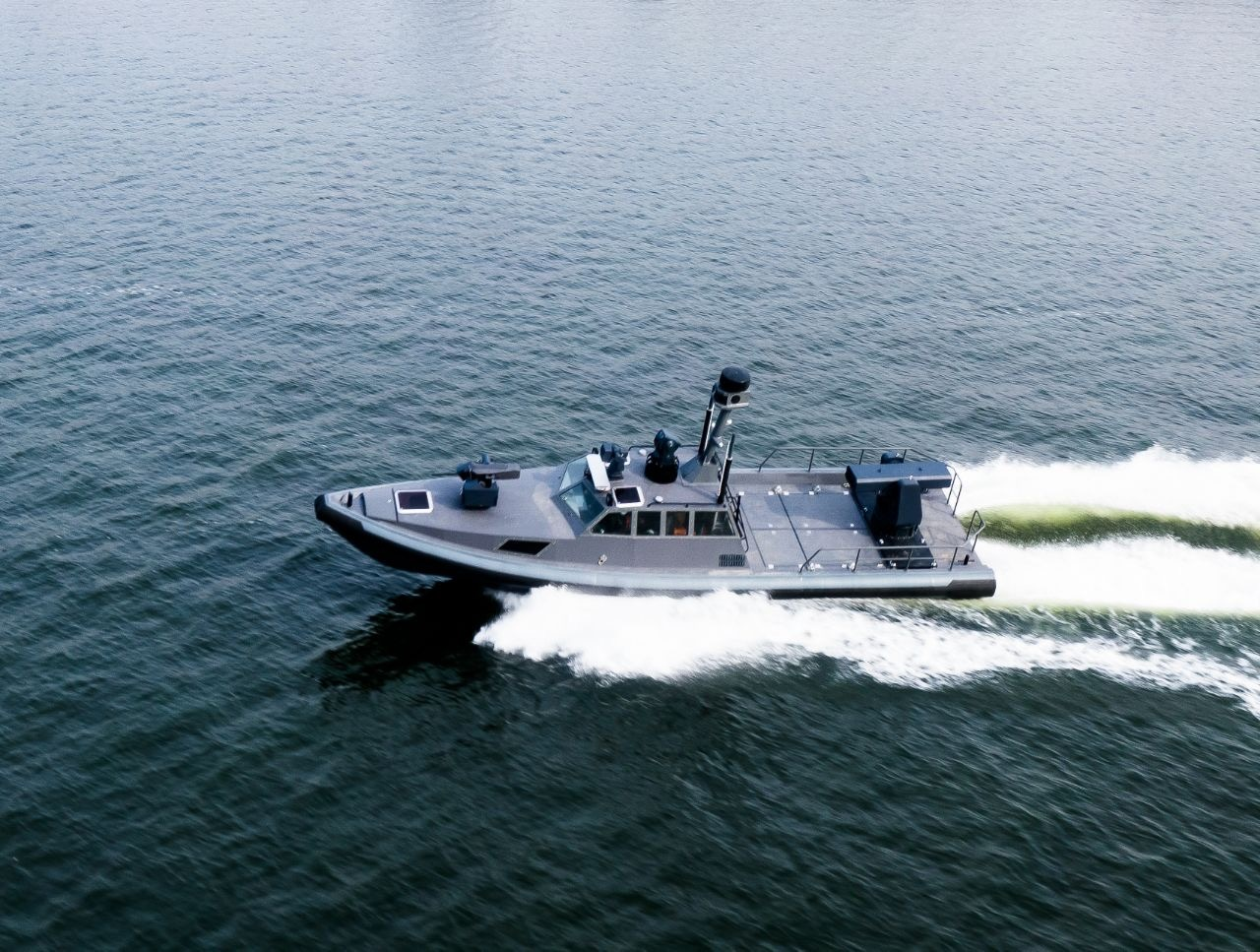
Successful demonstration of Korea’s first integrated swarm operation involving heterogeneous unmanned systems, together with hybrid validation combining live systems and simulators
- Time from target detection to engagement reduced by up to 90% through AI-enabled command and control, delivering a breakthrough in battlefield speed
LIG Defense & Aerospace (LIG D&A) has successfully demonstrated the operational capabilities of its next-generation defense technologies integrating unmanned platforms with artificial intelligence (AI). Developed in collaboration with global AI leader Palantir Technologies, LIG D&A’s AI-powered decision-support solution is expected to enhance the company’s competitiveness in both domestic and international defense markets by incorporating evolving requirements of overseas customers and enabling agile responses to rapidly changing battlefield environments.
On May 27, LIG D&A hosted the “Intelligent Command and Control Demonstration for Unmanned Surface Vessels (USVs)” at Korea Maritime & Ocean University (KMOU), showcasing its AI-enabled multi-purpose unmanned system technology built around the two defining attributes of future warfare: “speed” and “integration.” Observed by officials from the Republic of Korea Armed Forces, the Korea Coast Guard, academia, and the defense industry, the demonstration marked Korea’s first successful “integrated swarm operation involving heterogeneous unmanned systems,” enabling different types of USVs to be controlled through a single coordinated system.
- Live-virtual integration—anti-surface and anti-submarine warfare flawlessly executed in a hybrid environment
At the core of this project is the creation of a “hybrid simulation” environment connecting physical maritime assets to a high-fidelity simulator in real time via satellite communications. A total of four live systems were deployed in the waters near KMOU: LIG D&A’s flagship USVs, Sea Sword-3 and Sea Sword-5, along with two Sea Sword-S small multi-purpose USVs manufactured using 3D-printing technology. The maritime maneuvering of the Sea Sword-S was demonstrated publicly for the first time.
The virtual simulation environment accurately recreated a multi-domain battlespace featuring hostile forces and a range of operational assets, including a manned destroyer, torpedoes, sonobuoys, and loitering munitions, closely replicating real-world combat conditions.
The demonstration featured two operational scenarios: anti-surface warfare (ASuW) and anti-submarine warfare (ASW). In the ASuW scenario, an enemy surface vessel was assumed to have crossed the Northern Limit Line (NLL). The system seamlessly executed a five-stage operational sequence, from operational planning and warning fire to engagement fire and a collision attack carried out by the Sea Sword-S. In the ASW scenario, the system demonstrated a complete seven-stage AI-enabled command-and-control sequence in real time—from initial search operations using deployed sonobuoys and a towed array sonar system (TASS) to the launch of a Blue Shark lightweight torpedo and simulated confirmation of the target’s destruction.
- Time from detection to engagement reduced to one-tenth, with prototype developed “in just four months”
LIG D&A's intelligent command-and-control (C2) system fuses real-time multi-domain data collected across maritime, air, and space domains into a single high-fidelity operational picture. In particular, the AI recommends tactical courses of action in real time, enabling commanders to make timely and informed decisions.
When fielded, the system can reduce the time required from target detection through command decision to engagement to one-tenth of that required by conventional systems, providing a decisive operational advantage in modern warfare. Furthermore, it enables uninterrupted, around-the-clock unmanned operations, independent of human crew rotations.
LIG D&A has radically compressed the development timeline for complex defense systems, which typically takes several years. By completing the project's prototype in just four months, the company achieved a “breakthrough in development speed” across both hardware and software.
- “Open Platform, Closed Core” strategy to balance interoperability with defense data sovereignty
LIG D&A presented “Open Platform, Closed Core” as its core technology strategy to lead the future unmanned systems market. This strategy involves adopting globally recognized standard architectures to ensure flexible interoperability with diverse systems while reducing development costs and strengthening export competitiveness (Open Platform). Meanwhile, it establishes Sovereign AI through proprietary defense-data training and closed-network operations to thoroughly safeguard defense data sovereignty and information security (Closed Core). This architectural framework closely mirrors the U.S. military’s Maven Smart System, paving the way for seamless coordinated operations with allied nations.
“True future defense competitiveness does not lie merely in possessing superior unmanned platforms but in integrating them into a single operational framework and using AI to command and control battlefield situations in real time,” said Lee Seung-young, Chief Technology Officer (CTO) and Head of the Technology Innovation Division at LIG D&A. He also added, “This demonstration marks the first step in turning that vision into reality, and we will continue to expand our interoperability platform, accelerate commercialization, and ultimately deliver global defense solution packages to customers around the world.”
A Palantir representative commented: “We consider it highly significant to accelerate AI integration with LIG D&A, one of the world's leading defense hardware manufacturers. This demonstration serves as proof of the achievements both companies have accomplished in a short period of time, and we look forward to creating even greater synergies through continued collaboration.”
LIG D&A plans to take the success of this demonstration as a springboard to continuously expand the scope of its interoperability platform and accelerate rigorous validation and roadmap execution for field deployment.